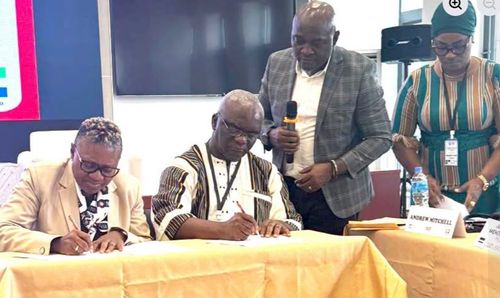
The Economic Community of West African States (ECOWAS) Commission and the South Centre extend their warmest congratulations to the Commissioner General of the Liberia Revenue Authority (LRA) and the Commissioner General of the National Revenue Authority of Sierra Leone (NRA) on the signing of the Memorandum of Understanding (MOU) in Abuja, Nigeria, on the 22nd of June 2026, for the conduct of a Simultaneous Tax Examination (STE), marking a significant moment in regional tax cooperation. As the first STE in the entirety of the Global South, it sets a powerful precedent for international tax cooperation. The leadership and commitment demonstrated by both Commissioners General have been instrumental in making this pioneering initiative a reality.
This MOU marks the formal operationalization of the ECOWAS-Led Simultaneous Tax Audit pilot program announced in April 2026, translating regional legal commitments under the ECOWAS Supplementary Act on Mutual Administrative Assistance in Tax Matters into administrative action that can deliver tangible revenue benefits to Member States.
ECOWAS and the South Centre reaffirm their commitment to strengthening regional tax cooperation and supporting domestic resource mobilization among their Member States, in furtherance of the ECOWAS Agenda 2050 and the Sustainable Development Goals.
ECOWAS and the South Centre stand fully behind the LRA and NRA as they embark on this landmark exercise, which will serve as a replicable model for future multilateral and bilateral STEs among other ECOWAS member states.
Abuja, Nigeria, June 22nd, 2026. Page 2 / 2
Directorate of Communication
PRESS RELEASE
---------------END-----------------
For further information, Kindly contact:
Directorate of Communication, ECOWAS Commission
Twitter: @ecowas_cedeao - Facebook: Ecowas-Cedeao
www.ecowas.int
About ECOWAS
The Heads of State and Government of fifteen West African Countries established the Economic Community of West African States (ECOWAS) when they signed the ECOWAS Treaty on the 28th of May 1975 in Lagos, Nigeria.
The Treaty of Lagos was signed by the 15 Heads of State and government of Benin, Burkina Faso, Côte d’Ivoire, The Gambia, Ghana, Guinea, Guinea Bissau, Liberia, Mali, Mauritania, Niger, Nigeria, Sierra Leone, Sénégal and Togo, with its stated mission to promote economic integration across the region. The Senegalese President was represented by the
Minister for Foreign Affairs. Cabo Verde joined the union in 1977. The only Arabic-speaking Member Mauritania withdrew in December 2000. Mauritania recently signed a new associate-membership agreement in August 2017. On January 29, 2025, Burkina Faso, Mali and Niger officially withdrew from ECOWAS.
The current Member States of ECOWAS are Benin, Cabo Verde, Côte d’Ivoire, The Gambia, Ghana, Guinea, Guinea Bissau, Liberia, Nigeria, Sierra Leone, Sénégal and Togo.
Considered one of the pillars of the African Economic Community, ECOWAS was set up to foster the ideals of collective self-sufficiency for its member states. As a trading union, it is also meant to create a single, large trading bloc through economic integration and cooperation.
Integrated economic activities as envisaged in the area that has a combined GDP of $734.8 billion, revolves around but are not limited to industry, transport, telecommunications, energy, agriculture, natural resources, commerce, monetary
and financial issues, social as well as cultural matters.
In 2007, ECOWAS Secretariat was transformed into a Commission. The Commission is headed by a President, assisted by a Vice President, five Commissioners and the Auditor-General of ECOWAS Institutions, comprising experienced bureaucrats who are providing leadership in this new orientation.
The ECOWAS budget is essentially financed by revenue collected through the Community tax. The tax was introduced to finance its activities. The rate of the Community levy is set at 0.5% of the CIF value of goods imported from non-ECOWAS countries.
As part of this renewal process, ECOWAS is implementing critical and strategic programmes that will deepen cohesion and progressively eliminate identified barriers to full integration. In this way, the estimated 300 million citizens of the community can ultimately take ownership for the realization of the new vision of moving from an ECOWAS of States to an “ECOWAS of the People: Peace and Prosperity to All” by 2050.